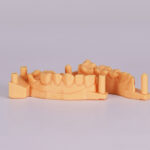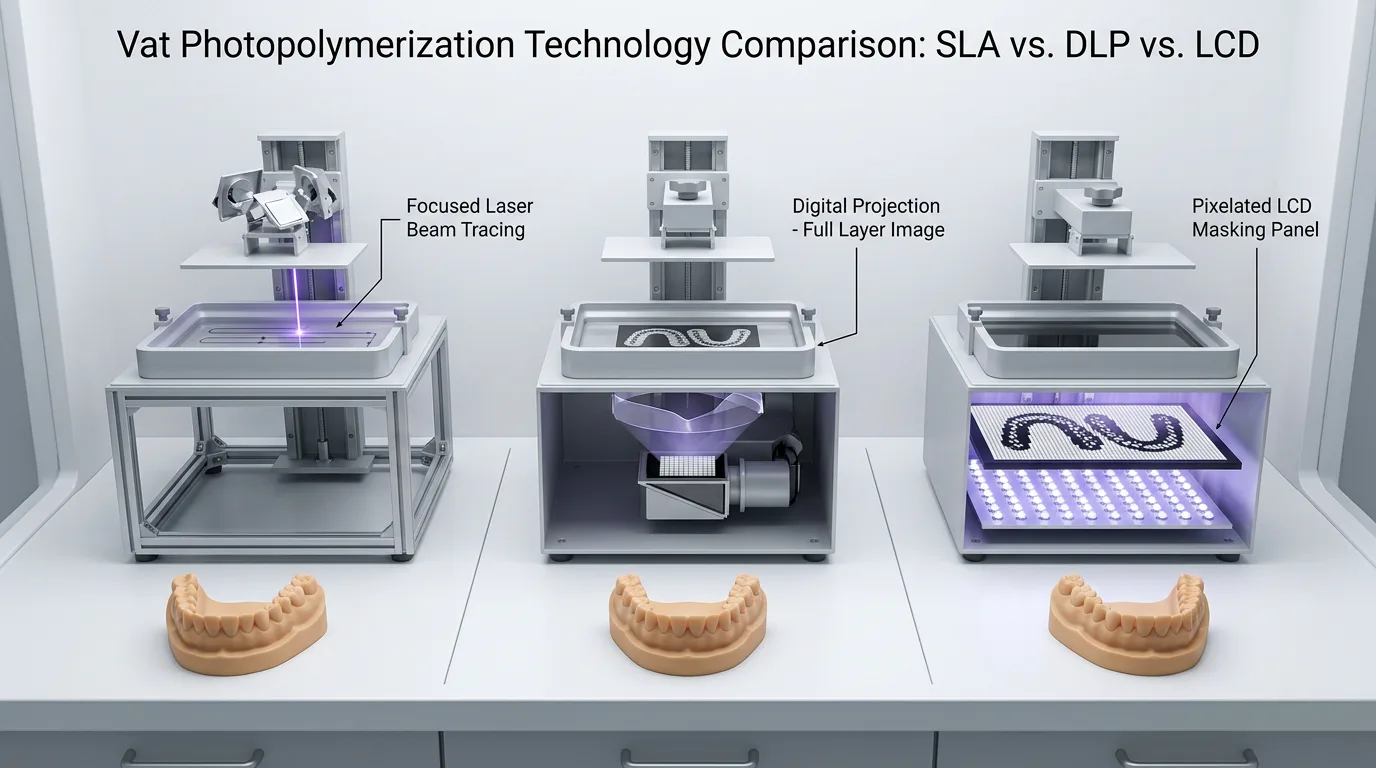
LCD, DLP and SLA dental printers can all use vat photopolymerization: a liquid photopolymer resin is selectively exposed to light and solidified layer by layer. The main difference is not that one uses resin and another does not. It is how each printer creates the exposure pattern for each layer.
In conventional laser SLA, a laser traces the layer. In DLP, a digital projection system exposes a two-dimensional layer image, commonly using a digital micromirror device. In LCD, or masked stereolithography, an LCD panel acts as a mask between the light source and the resin.
That difference affects optical resolution, exposure uniformity, scaling behavior, print-time behavior and machine architecture. But it does not mean that the technology label alone determines the accuracy of a finished dental model.
A 2024 review of vat photopolymerization in dentistry identifies SLA, DLP and LCD/mSLA as the three major photopolymerization approaches currently relevant to dental practice.
First, what do SLA, DLP and LCD have in common?
All three processes typically begin with a digital dental file that is prepared in slicing software. The software divides the model into layers and defines parameters such as orientation, supports and layer thickness.
During printing, photosensitive resin in a vat is exposed according to the geometry of each layer. After one layer is formed, the machine moves along the Z-axis, resin is replenished beneath or above the part depending on the machine architecture, and the next layer is exposed.
The printed object is therefore only one stage in a larger workflow:
digital model → slicing → orientation and supports → exposure → part removal → washing → drying → post-curing → support removal/finishing → inspection
The American Dental Association likewise treats printer type as only one part of equipment selection. Its 3D Printing Guide recommends evaluating intended use, materials, build-platform size, software, additional washing and curing equipment, accuracy, capacity, training, support and total workflow requirements.
This is important because two printers using the same basic exposure technology can produce meaningfully different results.
How SLA forms each layer
Traditional stereolithography uses a focused light source—typically a laser—that moves across the resin and traces the geometry of the current layer.
Instead of exposing every location simultaneously, the laser is directed to the areas that must be polymerized. Mirrors or other scanning optics position the beam as the layer is drawn.
Conceptually:
Laser → scanning optics → moving exposure point → resin
This means SLA is fundamentally a scanning process.
The effective detail that can be produced depends on factors including laser spot characteristics, optical control, positioning accuracy, exposure strategy and resin response. The laser spot should therefore not be interpreted as an automatic specification for finished-part accuracy.
Another practical difference is printing-time behavior. Because the laser must trace the regions being cured, the amount and geometry of material exposed within a layer can influence exposure time. A build containing more or larger cross-sectional areas may therefore behave differently from one containing a small object.
That is different from projection-based systems, where an entire layer image can be exposed at once.
How DLP forms each layer
Digital Light Processing uses a projector to create the image corresponding to the layer.
A typical DLP system incorporates a digital micromirror device, or DMD. It contains a large array of microscopic mirrors. Individual mirrors direct light either toward or away from the resin, producing the required exposure pattern.
Conceptually:
Light source → DMD micromirror array → projection optics → layer image → resin
Instead of tracing individual features sequentially, DLP can expose a complete two-dimensional layer pattern.
That is why DLP printing time is generally less dependent on how much of the XY area is filled than scanning SLA. Adding several models to the same layer does not necessarily multiply exposure time in the way that tracing additional geometry might.
But “DLP is faster” is still too simplistic.
Total build time also depends on:
- number of layers
- model height
- layer thickness
- exposure requirements
- resin viscosity and behavior
- separation or peel movement
- lift and return settings
- resin replenishment
- machine-specific motion strategies
The projected pixel size is also related to the optical system and projected image area. Projection magnification, optical correction and calibration therefore matter when assessing DLP performance.
How LCD or masked stereolithography forms each layer
LCD printing also exposes a large portion—or effectively all—of a layer simultaneously, but it creates the pattern differently.
A UV light source sits behind an LCD panel. The panel functions as a dynamic mask, allowing light through where the resin should cure while blocking or attenuating light elsewhere.
Conceptually:
UV light source → LCD mask → resin
This architecture is why terms such as LCD, masked SLA, MSLA and mSLA are often encountered in resin printing discussions.
The XY sampling of an LCD system is closely related to the panel’s physical pixel arrangement. However, a screen being advertised as “8K”, “12K” or “14K” does not by itself tell you the dimensional accuracy of a dental arch.
Practical output also depends on light collimation, optical diffusion, exposure compensation, resin behavior and the mechanical system. Reviews of mSLA specifically note that theoretical pixel resolution can be reduced in practice by optical effects such as light diffusion between neighboring regions.
That is why comparing only the number printed next to the letter “K” is not a reliable way to compare dental printers.
LCD vs DLP vs SLA: the differences that matter
| Consideration | SLA | DLP | LCD / mSLA |
|---|---|---|---|
| Layer formation | Laser traces the layer | Projector displays layer image | LCD masks light for the layer |
| XY characteristic | Laser spot and scanning system | Projected pixel and optics | Physical LCD pixel plus optical system |
| Exposure behavior | Sequential scanning | Whole-layer projection | Whole-layer masked exposure |
| Build-area influence | More geometry can increase scanning work | Projection area affects optical design and pixel scale | Panel size and pixel count define native exposure grid |
| Key calibration concerns | Laser positioning and optics | Projection geometry and optical correction | Light uniformity, mask behavior and exposure |
| Print-time behavior | More dependent on scanned geometry | More strongly driven by layer count and motion cycle | More strongly driven by layer count and motion cycle |
| Typical optical maintenance consideration | Laser/scanning optical system | Projector/DMD optical system | LCD panel and backlight system |
| Dental suitability | Depends on complete validated system | Depends on complete validated system | Depends on complete validated system |
This table describes architectural tendencies—not a ranking.
What is the difference between LCD and DLP dental printers?
This is where terminology often becomes confusing.
Both DLP and LCD usually expose a complete layer rather than tracing it with a laser, but the image-generation device is different.
A DLP printer normally creates the image using a digital micromirror array and then projects that image through an optical system.
An LCD printer uses a physical liquid-crystal panel as the mask through which the exposure light passes.
That difference influences how pixel size, build area, light distribution and calibration behave.
For DLP, the projected pixel is tied to the projector and its optical magnification. Changing the projected field involves an optical trade-off between area and effective pixel dimensions.
For LCD, the pixel grid is physically distributed across the panel. A larger or higher-pixel-count panel changes the native sampling grid, but actual curing still depends on the quality and uniformity of the illumination reaching the resin.
Neither architecture eliminates the need for calibration.
Does one technology produce more accurate dental models?
Not automatically.
This is one of the most important points when comparing LCD vs DLP vs SLA for dental 3D printing.
A systematic review of full-arch printed dental models reported substantial variation even within individual printing technologies. SLA results, for example, included both the smallest and the largest mean errors among printers examined in the review. The authors also identified manufacturing parameters, base design and post-processing as significant factors.
That variability makes statements such as:
“DLP is always more accurate.”
or
“SLA automatically produces better dental models.”
scientifically difficult to justify.
Some systematic reviews have reported stronger results for DLP or SLA in particular datasets. One network meta-analysis concluded that SLA and DLP were among the better-performing technologies for full-arch models, while LCD performed less favorably in the studies available to that analysis. However, the available LCD evidence was more limited, and printer generation, price class, material system and study methodology vary substantially.
The useful question is therefore not:
“Which technology is the most accurate?”
It is:
“Can this exact printer-material-process combination repeatedly produce my required dental part within my acceptance criteria?”
Why printer technology is only one variable
Dental printing accuracy is the result of an entire process chain.
Material
Photopolymer chemistry influences exposure behavior, polymerization shrinkage, viscosity, mechanical properties and post-curing response.
Even two resins that respond to the same nominal wavelength should not automatically be treated as interchangeable.
Printer calibration
Exposure, platform setup, dimensional compensation and optical calibration can affect the final model.
A high-resolution exposure device operated with an unsuitable profile can still produce poor dimensional results.
Orientation
Dental model orientation changes layer geometry, support loading, peeling forces and surface distribution.
Research has demonstrated measurable changes in trueness and precision when dental models are printed at different orientations.
Layer thickness
Smaller layers can improve some surface characteristics, but a lower layer-height number does not guarantee greater overall dimensional accuracy. It also increases the number of printing cycles.
Geometry and support strategy
Full-arch models, quadrant models, removable dies, splints and thin appliance geometries do not behave identically.
Base design and support placement can influence deformation and dimensional stability. Systematic-review evidence has specifically identified dental model base design as an accuracy-related factor.
Washing and post-curing
Printing stops when the object leaves the printer, but dimensional and material development does not necessarily stop there.
Washing removes residual uncured resin, while post-curing further polymerizes the printed material. Research has shown that changes in post-processing can influence dimensional and material properties, which is why validated material instructions should be followed instead of applying one universal cleaning and curing cycle.
Build area matters differently from headline resolution
Dental laboratories should also consider usable production capacity, not simply optical resolution.
A printer may have a large nominal build area but still fit fewer usable full-arch models once orientation, spacing and supports are considered.
Conversely, a smaller platform may be adequate for a laboratory producing predominantly quadrant models or small batches.
The ADA specifically lists build-platform size as a factor affecting the volume and type of products that can be printed.
For DLP and LCD systems in particular, filling more XY space does not necessarily increase the exposure portion of every layer proportionally. However, greater model height still creates more layers, and a heavily populated platform may affect separation forces, resin replenishment and workflow reliability.
So “whole-layer exposure” should not be translated into “unlimited parts at the same speed.”
Repeatability may matter more than a single accuracy result
A dental lab normally does not need one unusually good sample.
It needs the same workflow to work repeatedly.
That means measuring both:
Trueness: how closely a printed model matches the reference geometry.
Precision: how closely repeated prints agree with one another.
A machine that occasionally produces an excellent model but shows large batch-to-batch variation may be less useful than a system with slightly different nominal specifications but stronger repeatability.
This is another reason that screen resolution, laser spot size or projected pixel dimensions should not be used as substitutes for actual model testing.
Material compatibility and workflow can outweigh the optical architecture
Printer selection also needs to consider whether the materials required by the laboratory have documented profiles for the machine.
For dental working models, the evaluation may be relatively straightforward.
For surgical guides, splints, temporary restorations, dentures or other patient-contact applications, the question becomes much more demanding. The exact resin, printer, print parameters, washing procedure, curing equipment and intended use need to be considered as a validated system rather than independently.
The ADA includes material compatibility, software, additional post-processing equipment and intended clinical capability among its purchasing considerations.
Which one should a dental lab choose?
Do not choose solely because a printer says SLA, DLP, 8K, 14K or LCD.
Start with the application.
Ask:
What do we need to print?
Then evaluate:
application + validated material + measured sample performance + capacity + workflow
A laboratory primarily producing large batches of orthodontic working models may value platform utilization, throughput and repeatability differently from a laboratory producing removable dies or precision prosthodontic working models.
Likewise, a workflow requiring a documented patient-contact material may place material-system validation ahead of nominal screen resolution.
The ADA makes essentially the same purchasing point in simpler terms: before selecting the printer, determine what you are trying to accomplish.
For practical evaluation, send the same representative dental file to each candidate system, use the intended resin and documented workflow, and compare:
- dimensional measurements
- fit-critical areas
- surface quality
- repeated-print consistency
- usable models per build
- print and post-processing time
- support removal
- failure/reprint rate
- material documentation
- maintenance requirements
- operator workload
That test will usually tell a dental laboratory more than the technology acronym on the specification sheet.
A note on current Yidimu dental printers
The current minidimu.com product information lists both the Eternal D1 and Eternal Y8 as LCD-based dental resin printers. The D1 page describes a 10.1-inch monochrome LCD exposure system, while the Y8 page specifies a 10.3-inch monochrome LCD system. Both pages also explicitly caution that screen resolution or XY display values should not be interpreted as guaranteed finished-part dimensional accuracy.
That is the appropriate way to evaluate LCD technology in a professional dental workflow: not by assuming LCD is better or worse than DLP or SLA, but by validating the actual printer, resin, model, settings and post-processing process.
The practical conclusion
The most important difference between SLA, DLP and LCD dental printers is how they form the light pattern that cures each layer.
SLA traces the geometry with a laser. DLP projects the geometry using a micromirror-based optical system. LCD places a pixelated mask between the light source and resin.
Those architectures influence resolution behavior, build-area scaling, optical uniformity, calibration, maintenance and print-time behavior.
They do not, however, provide a universal ranking of dental print quality.
For a dental laboratory, the more useful comparison is not simply LCD vs DLP vs SLA. It is the performance of a specific printer + material + calibration + model orientation + support strategy + washing + post-curing + inspection workflow.
Choose the system that repeatedly produces the parts your laboratory actually needs—not the technology name that looks strongest on a specification sheet.