The price of a dental 3D printer is only the first part of the investment. A realistic budget should include the printer, compatible resin, washing and curing, software, labor, maintenance, failed prints, workspace and other workflow costs.
So, how much does a dental 3D printer cost? There is no single useful number for every dental laboratory. The American Dental Association’s current “How to choose a 3-D printer” resource lists a broad price range from $5,000 to more than $100,000 and separately advises buyers to consider IT upgrades, support, training, material costs, time, space, software and maintenance. That range covers very different types and configurations of dental printing systems, so it should not be treated as a quotation for any specific printer.
For a dental lab, the better question is therefore not simply “What does the printer cost?” but “What will this printing workflow cost us to operate at the volume and quality level we need?”
Start with the Initial Equipment Cost
The printer is usually the most visible part of the investment, but it may not be the only equipment that needs to be purchased.
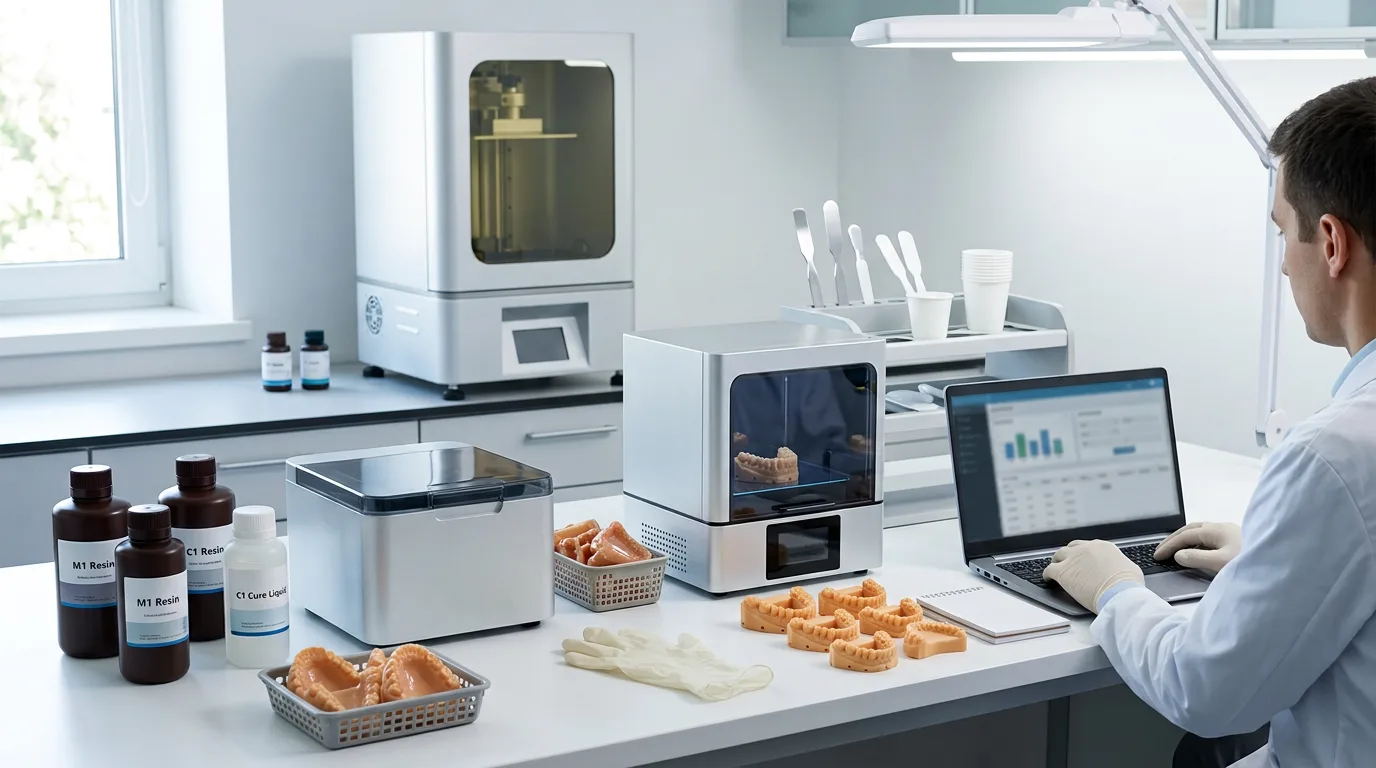
A practical initial equipment budget may include:
- the dental resin 3D printer;
- washing equipment or controlled cleaning containers;
- UV post-curing equipment;
- build platforms, resin vats and workflow accessories;
- a suitable computer or IT upgrade where required;
- storage, handling and inspection equipment.
The ADA specifically identifies additional washing and curing equipment as a consideration and also advises buyers to check whether existing computers can support the required software.
This is particularly important with resin printing because printing is only one stage of the process.
For example, Yidimu’s current dental workflow information describes printed resin parts as moving through washing, complete drying, UV post-curing and inspection rather than becoming finished parts immediately when they leave the printer. Its current YDM-UV-350 page presents UV curing as a dedicated post-processing stage after washing and drying.
At the time of this review, minidimu.com does not publish a selling price for the Eternal D1 or Eternal Y8 dental printers. The current Y8 page instead asks buyers to provide application and production information before requesting a quotation. No Yidimu price should therefore be inferred from general market ranges.
Recurring Production Cost
Once a printer enters daily production, materials and consumables become a continuing expense.
The most obvious recurring cost is resin, but resin consumption alone does not represent the complete production cost.
A laboratory may also need to budget for:
- cleaning liquids or other approved washing media;
- gloves and other PPE;
- filters and disposable cleaning materials;
- vat films or other replaceable printer consumables;
- containers and handling supplies;
- waste-management materials;
- electricity where it is material to the operation.
The exact cleaning cost also depends on the resin system. Dental resins should not automatically be assumed to use the same washing medium or cleaning process.
Yidimu’s current resin documentation, for example, separates model resin, washable model resin and castable pattern resin workflows and states that cleaning and post-curing requirements need to be confirmed for the exact material.
This means a cost-per-model calculation should use the actual resin and workflow being operated rather than a generic resin price.
Software Can Be a Separate Cost Layer
Software costs are easy to overlook because some printer packages include basic slicing tools while other dental workflows depend on additional software.
Potential software expenses include:
- CAD or dental design software;
- printer slicing software;
- treatment-planning tools where applicable;
- cloud-based workflow software;
- subscriptions;
- software updates or support plans.
The ADA specifically recommends checking whether additional software is required for design or treatment planning and whether printer software is compatible with existing CAD systems. It also lists software and software-update costs among the financial considerations when evaluating a printer.
Before purchasing equipment, a lab should therefore map the complete digital chain from the incoming scan or model file to the printable file.
A low printer purchase price becomes much less important if using it requires expensive software changes elsewhere in the workflow.
Labor Is Part of Every Printed Model
A 3D printer may automate layer-by-layer manufacturing, but dental resin printing is not a labor-free process.
Staff time can be required for:
file preparation → orientation and support setup → printer preparation → part removal → washing → drying → UV post-curing → support removal → inspection → equipment cleaning and maintenance.
Yidimu’s current Eternal Y8 workflow, for example, describes separate stages for reviewing the model, orienting and supporting it, preparing resin, printing, removing the build, cleaning and drying, post-curing, and final inspection.
For budgeting purposes, this labor should be assigned a cost.
A useful internal calculation is:
Labor cost per batch = total hands-on processing time × loaded labor rate
Hands-on time matters more than simply measuring how long the printer is running. A six-hour print does not necessarily require six hours of technician labor, but preparation, washing, curing and inspection still require staff capacity.
Training should also be included during implementation. The ADA identifies both training cost and the learning curve as factors that affect adoption and return on investment.
Failed Prints and Reprints Are Quality Costs
Not every resin poured into a printer becomes a usable dental model.
Failed prints can consume:
- resin;
- technician time;
- cleaning materials;
- printer capacity;
- post-processing capacity;
- delivery time.
There is also a less obvious quality cost: a model may complete successfully but still fail dimensional or application requirements.
Possible causes include unsuitable orientation, support placement, exposure settings, resin condition, machine condition, washing, curing or incorrect material selection.
The ADA includes remakes and adjustment time among the considerations related to printing accuracy and capacity.
Yidimu similarly notes that final dimensional performance depends on the complete combination of printer, resin and post-processing rather than screen resolution alone.
For this reason, a realistic cost-per-model calculation should use the number of accepted parts, not simply the number of parts that were started.
For example:
Effective material cost per accepted model = total material consumed ÷ accepted models
If 100 models are started but only 95 satisfy the laboratory’s acceptance criteria, the five unsuccessful parts still contributed to production cost.
Capacity Can Matter More Than Purchase Price
One of the most important cost questions is also one of the easiest to miss: can the printer produce enough parts for the laboratory’s actual workload?
A cheaper printer is not automatically the lower-cost option.
If limited build area or throughput forces a lab to:
- run additional print jobs;
- operate equipment for longer hours;
- assign more technician time;
- delay downstream production;
- purchase another printer sooner;
then the lower purchase price may provide little financial advantage.
The ADA specifically recommends considering build-platform size, print volume, print time, curing time and expected volume when calculating return on investment.
For example, Yidimu lists a 228 × 128 × 235 mm build volume for the Eternal Y8 and 223 × 126 × 290 mm for the Eternal D1. These dimensions do not tell a lab exactly how many dental models it can produce per job because actual capacity also depends on model geometry, orientation, supports and spacing.
Capacity should therefore be tested with representative production files rather than estimated from printer price alone.
A Simple Dental 3D Printing TCO Formula
For budgeting purposes, total cost of ownership can be expressed as:
**TCO = equipment acquisition
- post-processing equipment
- software
- consumables
- materials
- labor
- maintenance
- failed and reprinted parts**
Depending on the laboratory, it may also be useful to add IT upgrades, workspace preparation, training, support contracts and waste-management costs.
The calculation becomes more useful when it is converted into a production metric:
TCO per accepted part = total workflow cost over the measurement period ÷ number of accepted parts produced
Do not assume an annual number before you know your own production volume.
A laboratory printing ten models per week and a laboratory printing hundreds of models per week can own the same printer but have very different cost per part.
What Is the Total Cost of Dental 3D Printing?
The total cost of dental 3D printing is the cost of operating the complete digital manufacturing workflow, not merely purchasing the printer.
For most professional teams, the major cost layers are equipment, resin and consumables, post-processing, software, labor, maintenance, quality losses and production capacity.
This is also why comparing two printers only by purchase price can be misleading. The lower-priced system may be economical for one laboratory and expensive for another if it creates additional labor, insufficient capacity or frequent reprints.
Before requesting a quotation, collect a small set of real production information:
- the models or parts you expect to print;
- typical model dimensions;
- expected daily or weekly quantity;
- resin requirements;
- current software;
- available washing and curing equipment;
- staff time available for post-processing;
- inspection requirements.
Then evaluate the printer as one part of that workflow.
For Yidimu equipment, current minidimu.com product pages provide specifications and workflow information for the Eternal D1, Eternal Y8, dental resins and UV curing equipment but do not publish a fixed online selling price. A commercial quotation should therefore be requested for the actual printer configuration, resin requirements, post-processing setup and destination rather than estimated from third-party market pricing.
For a dental lab building a realistic budget, that is the useful distinction:
Printer price tells you what it costs to acquire the machine. Total cost of ownership tells you what it costs to produce with it.