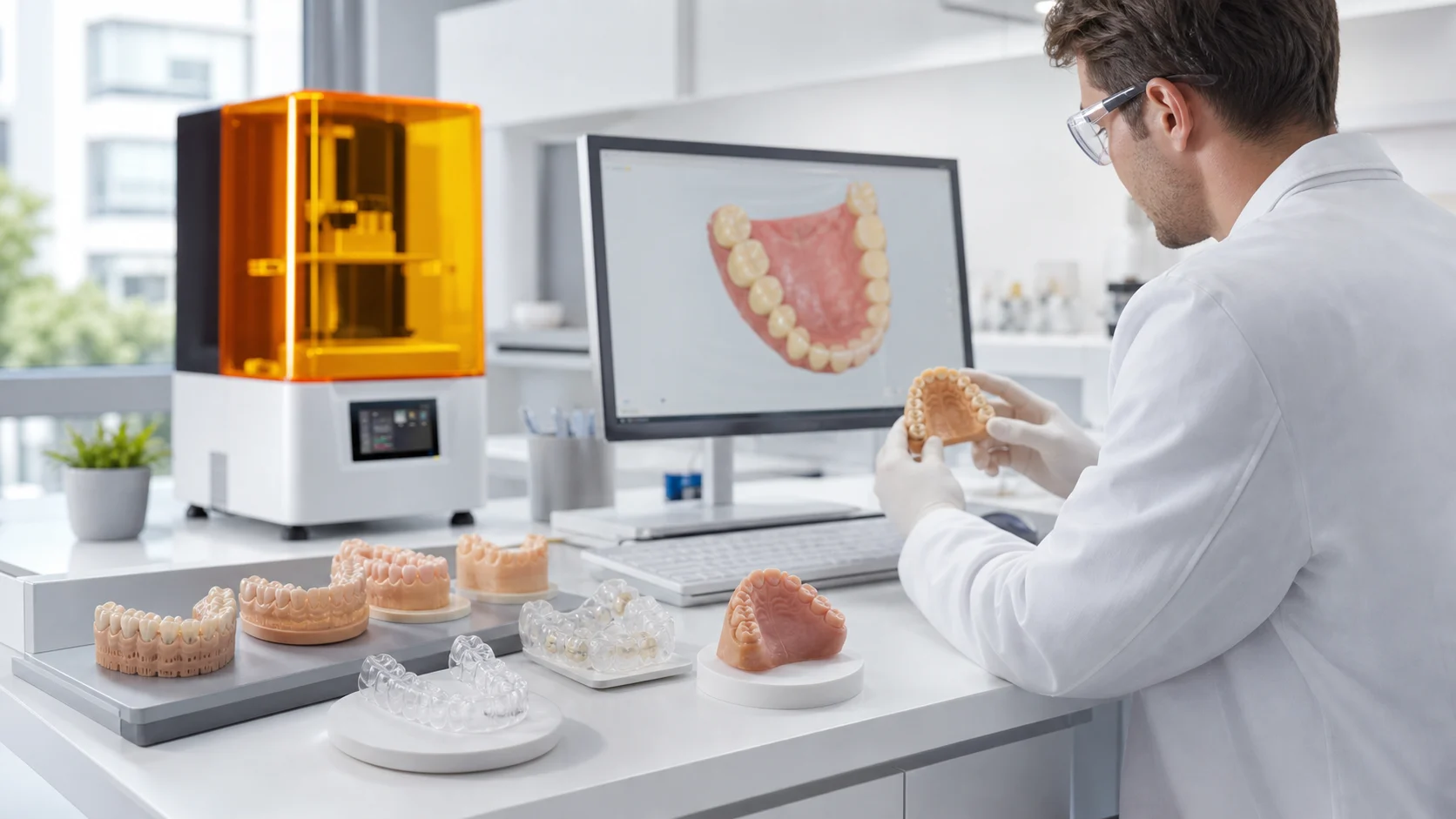
A dental 3D printer is mainly used to turn digital dental designs into physical models, patterns, and other parts for laboratory or clinical workflows. Common uses include dental working models, orthodontic models, clear aligner working models, removable-die models, restorative models, implant-related models, and castable patterns. Some systems can also produce patient-contact devices, but only when the exact resin, printer, post-processing process, and intended use are properly documented and validated.
That last distinction matters. A printer being marketed for dentistry does not mean every object printed on it is suitable for use inside a patient’s mouth.
What does a dental 3D printer actually do?
Most professional dental resin printers start with a digital 3D file produced from an intraoral scan, laboratory scan, CAD design, or another approved digital workflow.
The file is prepared in software, oriented, supported where necessary, sliced into layers, and then printed in photopolymer resin. After printing, the part normally goes through cleaning, complete drying, support processing where applicable, UV post-curing, and final inspection. The precise procedure depends on the material and intended application.
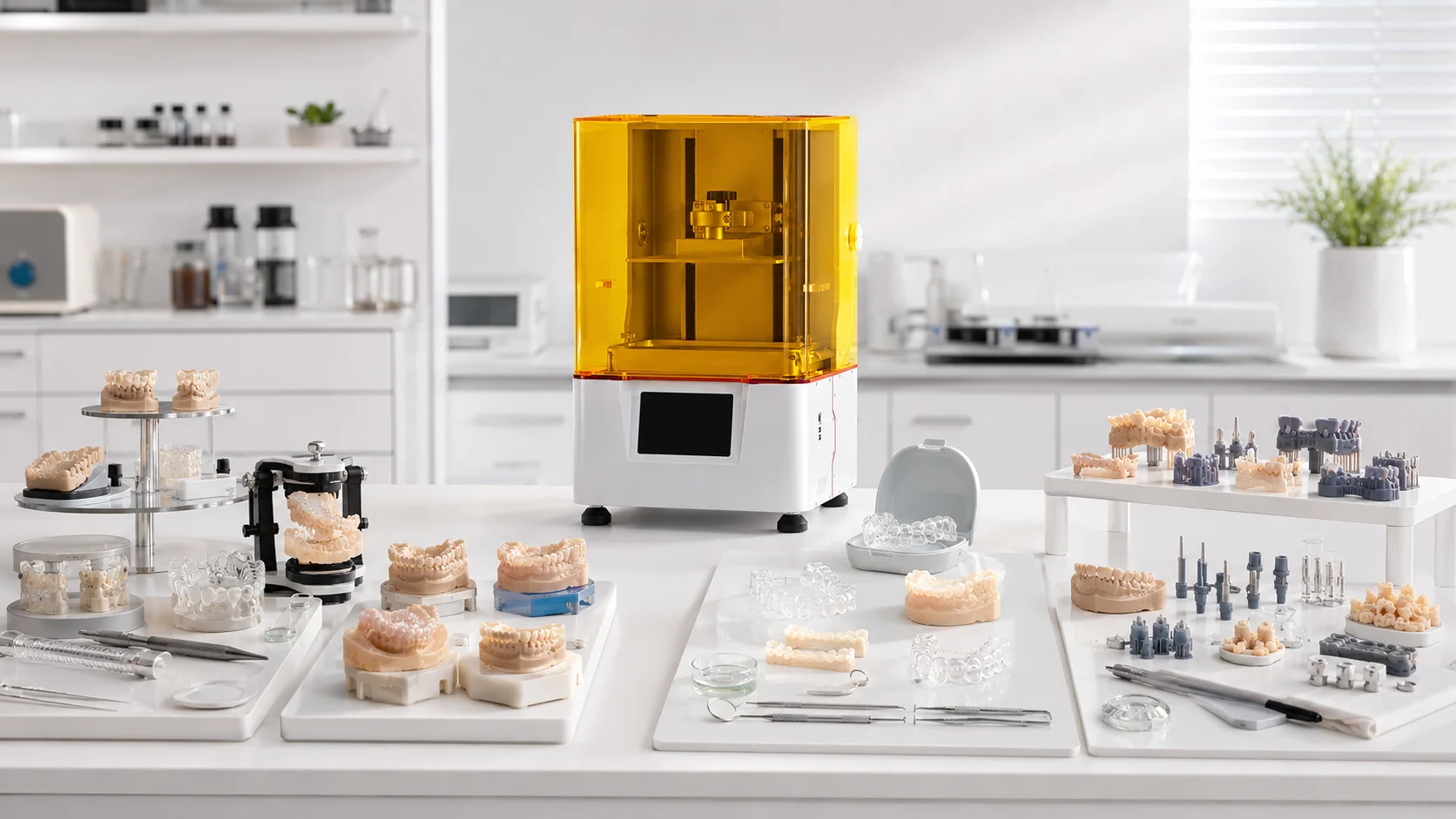
So the printer itself is only one part of the process.
A more useful way to think about dental 3D printing is:
digital file → print → clean → dry → post-cure → inspect → use in the intended workflow
You can see this process in more detail in Yidimu’s dental 3D printing workflow guide.
The most common uses of dental 3D printers
Dental working models
One of the most straightforward applications is producing physical dental models from digital scan data.
These models may be used for:
- morphology review
- laboratory planning
- restoration-related work
- fit evaluation
- case communication
- removable-die workflows
- checking component relationships
Instead of treating the printed model as the final treatment product, the model often serves as a physical reference within a larger digital manufacturing process.
Yidimu’s current application documentation specifically separates these working-model applications from direct intraoral products.
Orthodontic models
Dental 3D printers are also widely used to manufacture orthodontic study and working models.
Depending on the workflow, these can support:
- treatment-planning reviews
- setup models
- records
- appliance-related laboratory work
- staged model production
Peer-reviewed literature identifies orthodontics as one of the established fields using 3D printing, including the production of working models and various appliance-related workflows.
The printer, however, should not be judged only by whether it can produce something that looks like an accurate dental arch. Dimensional requirements, repeatability, orientation, material behavior, washing, curing, and the downstream process all matter.
Clear aligner working models
This is where terminology can become confusing.
A dental resin printer may be used to print positive working models over which an aligner is formed in a separate thermoforming process.
That is not the same thing as directly printing the aligner itself.
Yidimu’s current application page explicitly describes its clear aligner model workflow as positive models for a separately validated thermoforming process rather than directly printed aligners.
For laboratories evaluating this application, see the current dental 3D printing applications overview.
Restorative and removable-die models
Printed models can also support crown, bridge, removable-die, and other restorative laboratory workflows.
Here, the important question is not simply, “Can the printer reproduce small details?”
The laboratory needs to consider the features that affect the actual process, such as:
| Factor | Why It Matters | What to Check |
|---|---|---|
| Critical geometry | Small margins and removable features may affect downstream work | Inspect representative parts |
| Orientation | Changes support placement and surface behavior | Test the actual model orientation |
| Resin | Different materials behave differently during printing and curing | Confirm current material documentation |
| Post-curing | May influence the finished part | Follow material-specific instructions |
| Fit requirements | Visual quality alone does not establish dimensional suitability | Measure relevant features |
This is also why screen resolution should not be treated as a direct measurement of finished-model accuracy. Pixel size, optical behavior, calibration, resin properties, supports, orientation, cleaning, and post-curing can all influence the result. Yidimu’s current printer documentation makes the same distinction.
Implant-related working models
3D printing can produce physical models used during implant-related laboratory planning, component positioning, and workflow assessment.
These should again be distinguished from printed surgical guides or other patient-contact products.
A model used on a laboratory bench and a surgical guide used clinically have very different material, validation, documentation, and regulatory requirements.
The FDA notes that additive manufacturing is used for medical and dental devices, including patient-matched products, but the intended use and finished material matter when evaluating a medical device.
Castable patterns
Dental 3D printing can also be used to create patterns that later enter a casting workflow.
The printed resin pattern is not the finished metal restoration. It is one stage in a sequence that may involve:
printed pattern → investment → burnout → casting → finishing
The final result therefore depends on more than printer performance.
The selected resin must work with the investment material, burnout procedure, casting process, geometry, and finishing method. Yidimu currently lists castable dental resin as a separate material category rather than treating ordinary model resin as interchangeable with casting material.
What about crowns, splints, surgical guides, or dentures?
Dental 3D printing technology can be used in workflows involving restorations, surgical guides, dentures, orthodontic appliances, and other dental devices. Academic reviews document applications across prosthodontics, orthodontics, implantology, and oral surgery.
But this does not mean that every dental printer and every dental resin can produce these items for patient use.
For a patient-contact part, check at least:
- the exact resin product
- its documented intended use
- compatible printer or exposure system
- required print settings
- washing procedure
- drying requirements
- UV curing equipment and procedure
- any sterilization requirements
- applicable regulatory status
- the manufacturer’s current TDS, SDS and IFU
FDA information on printed dental devices similarly emphasizes the specific intended use and performance of the finished dental material rather than assuming that a generic printable material is appropriate for every application.
This is where people often get confused: “dental resin” is a product category, not a universal permission for intraoral use.
Model printing and patient-contact printing are different jobs
A practical distinction looks like this:
| Printed Part | Typical Purpose | Patient Contact? | Main Evaluation Question |
|---|---|---|---|
| Dental working model | Laboratory reference and production support | Usually no | Is the model dimensionally suitable for the workflow? |
| Orthodontic model | Records, setup, laboratory work | Usually no | Is geometry repeatable across the required model set? |
| Aligner working model | Positive model for a separate forming process | Usually no | Does the model meet the thermoforming workflow requirements? |
| Removable-die model | Restorative laboratory work | Usually no | Are critical features and fit-related geometry reproduced adequately? |
| Castable pattern | Intermediate pattern for casting | Usually no | Is the resin compatible with the complete casting process? |
| Surgical guide | Guided clinical procedure | Yes | Is the exact material/system documented for this intended use? |
| Splint or oral appliance | Direct patient use | Yes | Is the complete validated material and processing workflow supported? |
The application should therefore be defined before choosing the printer and resin.
Why dental labs use resin 3D printing instead of printing everything the same way
Different dental parts place different demands on the production process.
A full-arch model, a removable die, a batch of orthodontic models, and a castable pattern may differ in:
- geometry
- orientation
- support requirements
- resin selection
- batch layout
- surface requirements
- dimensional priorities
- post-processing
- inspection criteria
That is why selecting a dental printer by a single specification such as “8K,” “14K,” layer height, or advertised speed is a weak evaluation method.
The more useful question is:
Can this printer, material, software, post-processing process, and inspection method repeatedly produce the parts my workflow actually needs?
Yidimu’s current dental 3D printer overview follows this workflow-based approach rather than treating resolution alone as proof of suitability.
What happens after the dental model is printed?
Resin printing does not end when the build platform comes out of the printer.
A typical workflow includes:
- Inspect the completed build.
- Allow excess resin to drain appropriately.
- Wash the part according to the resin instructions.
- Allow it to dry completely.
- Process or remove supports as required.
- Perform the specified UV post-curing procedure.
- Inspect surfaces and relevant dimensions.
- Verify the part against the workflow’s acceptance criteria.
There is no responsible universal rule such as “wash every dental resin for X minutes” or “cure every model for Y minutes.”
Those parameters depend on the exact material, equipment, geometry, and intended use.
How should you decide whether a dental 3D printer fits your application?
Start with the part, not the printer specification sheet.
Before evaluating a system, collect:
- the STL or other representative model file
- maximum model dimensions
- intended application
- required material category
- expected number of parts
- critical surfaces or dimensions
- downstream process
- washing and curing requirements
- inspection method
Then print representative parts.
A generic demonstration model can show that a machine works. It does not necessarily show that the machine works for your dental workflow.
For a realistic equipment evaluation, use the same type of geometry, orientation, material direction, batch arrangement, and inspection criteria that you expect to use in production.
Yidimu provides a dental sample and project evaluation process for reviewing actual model requirements before deciding on a workflow.
Evaluating the workflow with your own model
If you are evaluating dental resin printing for a laboratory, clinic, orthodontic workflow, or model-production operation, a representative sample tells you more than a headline printer specification.
Useful project information includes:
- STL or model information
- model dimensions
- intended application
- material requirements
- expected quantity
- surface requirements
- critical dimensions
- current printing or post-processing problem
The important part is to evaluate the entire chain—file preparation, printer, resin, orientation, washing, drying, curing, and inspection—not just the printer sitting on the bench.
FAQ
Is a dental 3D printer only used for making dental models?
No. Dental 3D printing is used across model production, orthodontics, prosthodontics, implant-related workflows, casting processes, guides, appliances, and other applications. The exact printer and material requirements depend on what is being produced.
Can a dental 3D printer make clear aligners?
Some workflows print positive dental models that are subsequently used to thermoform aligners. Directly printing an aligner is a different application and requires a material and production system documented for that purpose.
Can dental model resin be used directly in the mouth?
Do not assume so. A model resin should only be considered for a patient-contact application when its specific intended use and applicable documentation support that application.
Does a higher-resolution dental printer automatically produce more accurate models?
No. Display resolution is only one characteristic of the imaging system. Finished results can also depend on calibration, pixel size, resin behavior, orientation, supports, layer settings, washing, post-curing, and part geometry.
What should I test before buying a dental 3D printer?
Print representative models using a relevant material and realistic layout, then inspect the dimensions, fit-related features, surfaces, repeatability, post-processing requirements, and practical batch workflow.
Sources:
- U.S. Food and Drug Administration — 3D Printing of Medical Devices.
- U.S. Food and Drug Administration — Process of 3D Printing Medical Devices, including printed dental materials and intended-use considerations.
- Chen Y, Wei J. Application of 3D Printing Technology in Dentistry: A Review. Polymers, 2025.
- Jeong M, et al. Materials and Applications of 3D Printing Technology in Dentistry: An Overview. Dental Journal, 2024.
- Balhaddad AA, et al. Three-dimensional (3D) printing in dental practice: Applications, areas of interest, and level of evidence. Clinical Oral Investigations, 2023.